BlinkGTK Application Integration API Reference — Custom Schemes, Messaging, Script Injection
Version: 1.2.2-build6
Last updated: 2026-07-30
About this page
APIs that connect your application and the web page in both directions:
- Create your own URL scheme — your application
answers URLs like
ebook://book/chapter1.html. An e-book reader can decrypt the contents of
an encrypted EPUB and hand them to the page, for example - Exchange messages with the page — call C callbacks
from the page's
JavaScript, and call the page's JavaScript from C - Inject scripts and CSS into every page — add your
application's
JavaScript or styles without touching the content
Beyond signatures, each API description includes its
behavioral details —
which thread it runs on, when it fires, who frees which memory, and
what
happens in edge cases. These descriptions were written against the
current
implementation; points that may improve in future versions are marked
with
"in the current implementation".
Getting started
/* Register the "app" scheme. The application answers app://... requests */
static char* on_app_scheme(BlinkWebView *view, const char *uri, gpointer data) {
    return g_strdup("<html><body><h1>Served by the app</h1></body></html>");
}

blink_web_view_register_custom_scheme(view, "app", on_app_scheme, NULL);
blink_web_view_load_uri(view, "app://home/");
Overview
| I want to… | API |
|---|---|
| Register a custom scheme (text response) | blink_web_view_register_custom_scheme() |
| Register a custom scheme (binary response + MIME) | blink_web_view_register_custom_scheme_full() |
| Receive JS → C messages | blink_web_view_register_message_handler() |
| Receive messages as a GObject signal (multiple subscribers) | the message-received signal |
| Unregister a message handler | blink_web_view_unregister_message_handler() |
| Send C → JS messages | blink_web_view_send_message_to_page() |
| Run JavaScript from C | blink_web_view_execute_javascript() |
| Inject a script | blink_web_view_inject_user_script() |
| Inject CSS | blink_web_view_inject_user_stylesheet() |
| Remove everything injected | blink_web_view_remove_all_user_scripts() |
Receiving the result
of execute_javascript()
The result given to the callback is a JSON
string.
static void on_js(const char *result, gpointer user_data) {
  /* result is never NULL */
  if (result[0] == '\0') {
    /* the script could not run (no WebContents / no main frame) */
    return;
  }
  /* parse as JSON from here. A value that could not be encoded arrives as "null" */
}
blink_web_view_execute_javascript(BLINK_WEB_VIEW(view), "1+1", on_js, NULL);
Note: result is never NULL. When the
script could not run you get an empty
string; when the value could not be encoded you get the four
characters
null. Checking only for NULL lets both cases through.
JSON.parse("") throws. Test for the
empty string first.
A script that returns a string yields a value wrapped in quotes
("...") —
it is JSON — so strcmp against the bare text will never
match.
Passing NULL as callback runs the script
without delivering a result.
Custom URL schemes
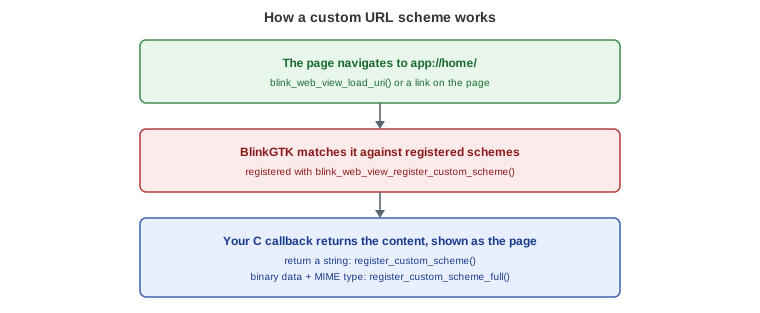
Three things to know first
- Scheme names are pre-registered. You can use the
five built-in names —
app/blinkgtk/res/resource/ebook— plus any names added
via theBLINKGTK_EXTRA_SCHEMESenvironment variable (comma-separated)
before startup. URL scheme classification is fixed early in the engine's
startup sequence, soregister_custom_scheme()cannot introduce new names
afterwards (see "Available scheme names" below) - Every kind of load fires the callback. Not just
top-level navigations:
subresources like<img src="app://...">, andfetch()/ XHR from
JavaScript all reach your handler. This is what makes it possible to run a
whole SPA (single-page application) on top of a custom scheme - The callback runs synchronously on the GTK main
thread. The UI is
blocked until your handler returns. Decrypting large files or waiting on
the network inside the handler freezes the window for that long. Do the
heavy preparation ahead of time and only hand out in-memory data from the
handler
blink_web_view_register_custom_scheme()
Registers a URI scheme. When a load for that scheme occurs, your
callback is
called instead of any network access, and the string it returns becomes
the
response.
Signature:
typedef char* (*BlinkCustomSchemeCallback)(BlinkWebView* web_view,
                                           const char* uri,
                                           gpointer user_data);

void blink_web_view_register_custom_scheme(BlinkWebView* web_view,
                                           const char* scheme,
                                           BlinkCustomSchemeCallback callback,
gpointer user_data);- Allocate the returned string with
g_strdup()or similar. Ownership
transfers to the engine, which frees it withg_free(). The response body
is copied internally, so reusing your buffers after the callback returns is
safe - The response is a C string, so it is cut at the first
0x00. Use
register_custom_scheme_full()for binary data such as images - Returning
NULLproduces an empty page (HTTP 200, zero-byte body).
The current implementation has no way to return a 404 or any other status
code. To express "not found" to the reader, return an HTML page that says so - Passing
NULLascallbackunregisters the scheme
blink_web_view_register_custom_scheme_full()
The binary-capable variant. Use it for anything that may contain
0x00 —
images, audio, fonts.
Signature:
typedef GBytes* (*BlinkCustomSchemeBytesCallback)(BlinkWebView* web_view,
                                                  const char* uri,
                                                  char** out_mime,
                                                  gpointer user_data);

void blink_web_view_register_custom_scheme_full(BlinkWebView* web_view,
                                                const char* scheme,
                                                BlinkCustomSchemeBytesCallback callback,
gpointer user_data);- Return the response as
GBytes(binary-safe because it carries its own
length). The engine callsg_bytes_unref()on it - Set
out_mimewith something likeg_strdup("image/jpeg"); the engine
frees it withg_free(). If you leave itNULL, the type is guessed from
the URI extension (see the table below) - Returning
NULLgives the same empty page (200) as the text variant
Example: serving an image from the application
static GBytes* on_ebook_scheme(BlinkWebView *view, const char *uri,
                               char **out_mime, gpointer data) {
    if (g_str_has_suffix(uri, "/cover.jpg")) {
        gsize len = 0;
        gchar *bytes = NULL;
        if (g_file_get_contents("/path/to/cover.jpg", &bytes, &len, NULL)) {
            *out_mime = g_strdup("image/jpeg");
            return g_bytes_new_take(bytes, len);
        }
    }
    return NULL;  /* becomes an empty page (200) */
}
What the URI looks like — parsing is the handler's job
Your callback receives the entire URI, such as
ebook://book/chapter1.xhtml?page=2. Splitting host and path
and interpreting
the query are up to you. Three things real applications trip on:
- Percent-decoding is required. Non-ASCII file names
arrive encoded, like
%E8%A1%A8%E7%B4%99.xhtml. Withoutg_uri_unescape_string()the file
lookup misses and "a file that exists" turns into a 404 - Reject path traversal. If you map paths to the file
system, letting
..through exposes files outside your content root. Do the check after
percent-decoding (to catch%2e%2e) - Decide what to do with query and fragment before stripping
them. If you
route purely on the path, strip everything from?; if some feature (such
as search) needs the query, save it first
static char* path_from_uri(const char *uri) {
    const char *p = strstr(uri, "://");
    if (!p) return NULL;
    const char *slash = strchr(p + 3, '/');          /* skip the host part */
    char *path = g_strdup(slash ? slash + 1 : "");
    char *q = strpbrk(path, "?#");                    /* strip query/fragment */
    if (q) *q = '\0';
    char *decoded = g_uri_unescape_string(path, NULL); /* 1: percent-decode */
    g_free(path);
    if (decoded && strstr(decoded, "..")) {           /* 2: reject traversal */
        g_free(decoded);
        return NULL;
    }
    return decoded;  /* path relative to your content root */
}
Available scheme names
| Scheme | Intended use |
|---|---|
app |
General (the application's own content) |
ebook |
E-book readers |
res / resource |
Generic resources |
blinkgtk |
Internal resource references |
| (any name) | Add before startup with
BLINKGTK_EXTRA_SCHEMES=myapp,plugin |
Why pre-registered: classifying a scheme as a
"standard scheme" (one with
scheme://host/path structure, where relative URLs resolve)
and as a secure
context happens early in engine startup and cannot be done later.
register_custom_scheme() runs after that point, so it
assigns a handler
to an already-registered name rather than adding new names.
A limitation of BLINKGTK_EXTRA_SCHEMES (current
implementation): schemes
added via the environment variable are rejected for fetch()
calls from page
JavaScript by a renderer-side gate (navigations and subresources such
as
<img> do work). If your SPA uses
fetch(), use one of the five built-in
schemes.
Why a custom scheme instead of file://
Local content can be shown over file://, but
file:// pages cannot use
fetch() and have a peculiar origin. Custom schemes are
treated as a real
origin with a secure context (HTTPS-equivalent), so
fetch(), Service
Workers and secure-context-only web APIs just work. The EPUB
reader
BlinkGTK-Readium serves the entire Readium SPA and all book data
over
ebook:// for exactly this reason — the
fetch()-based web app runs
unmodified where file:// could not support it.
Behavioral details
| Item | Current implementation |
|---|---|
| Loads that fire the callback | Navigations / subresources (<img> etc.) /
fetch() / XHR |
| Callback thread | GTK main thread, synchronous (UI blocked until return) |
| Process | The application (browser) process; renderers stay separate |
| Ownership of returned values | Transfers to the engine (g_free() /
g_bytes_unref()) |
| Content-Type | out_mime wins; otherwise guessed from the
extension |
| Extension guesses | .html/.htm→text/html, .css,
.js/.mjs, .json, .svg,
.png, .jpg/.jpeg, .webp,
.txt. Unknown extensions become
text/html |
| charset | Text-like MIME types always get utf-8 (not
configurable) |
Returning NULL |
Empty page (HTTP 200, zero bytes) — not a 404 |
| Status codes | Always 200; no way to specify |
| Redirects | Not possible (no way to return 3xx). Steer with HTML/JS in the body instead |
| Re-registering a scheme | Silently overwrites (last one wins) |
| Registration scope | Process-wide. If several WebViews register the same scheme, the last registration serves all of them |
Multiple WebViews: there is one registration per
scheme per process. To
serve different content per WebView, branch on the callback's
web_view
argument or use different scheme names. Also, in the current
implementation
destroying a WebView does not unregister its schemes —
unregister
(callback=NULL) before destroying it, or a handler pointing at
the destroyed
WebView remains registered.
Security note: the current implementation does not
check which page
initiated a request. If a handler returns sensitive data, either
avoid
displaying external content in the same WebView or validate URIs
strictly.
JS ↔︎ C messaging
A window.blinkgtk object is made available to JavaScript
running in the page.
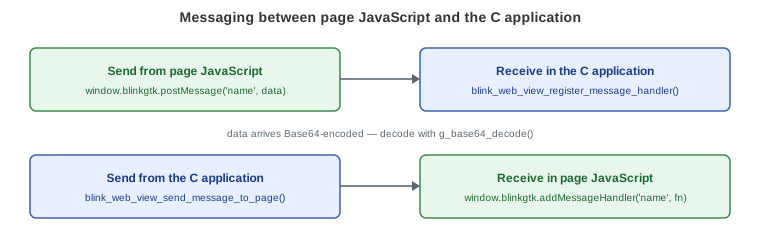
| Direction | JavaScript side | C side |
|---|---|---|
| JS → C | window.blinkgtk.postMessage('name', data) |
received via
blink_web_view_register_message_handler() |
| C → JS | received via
window.blinkgtk.addMessageHandler('name', fn) |
blink_web_view_send_message_to_page() |
Three things to know first
window.blinkgtkappears after the page finishes loading (onload).
It does not exist yet when inline scripts at the top of the page run.
Initialize the page side insidewindow.addEventListener('load', ...)or
after checking for its existence- JavaScript-side handler registrations are lost on
navigation (each new
document gets a freshwindow). The page must calladdMessageHandler
again on every navigation. The C-side handlers belong to the WebView
and survive navigations — no re-registration needed - The
datathat reaches C is a Base64-encoded byte sequence. Decode it
withg_base64_decode(). The reverse direction (C → JS) is not
Base64-encoded — the raw string is delivered. The encoding is asymmetric
blink_web_view_register_message_handler()
Registers a JS → C message handler.
Signature:
typedef void (*BlinkMessageCallback)(const char* name,
                                     const guint8* data,
                                     gsize length,
                                     gpointer user_data);

void blink_web_view_register_message_handler(BlinkWebView* web_view,
                                             const char* name,
                                             BlinkMessageCallback callback,
gpointer user_data);nameis the channel name. Use alphanumeric characters only (names
containing delimiter characters are not delivered correctly)- The callback runs on the GTK main thread; you can call GTK APIs directly
- Re-registering the same channel overwrites (one
handler per channel on
both the C and JS sides). To receive in several places, use the
message-receivedsignal below - The lifetime of
user_datais your responsibility (there is no destroy
notification). Pass data that outlives the WebView, or free it yourself when
you unregister
What you can pass from JavaScript (the
data of postMessage(name, data)):
| JS type | Behavior |
|---|---|
| string | Base64-encoded as UTF-8; non-ASCII text is safe |
ArrayBuffer |
Base64-encoded as raw bytes (binary-transparent) |
Uint8Array and other TypedArrays |
Not treated as ArrayBuffer — falls
through to JSON stringification ({"0":72,...}). Pass
.buffer instead |
| object / array / number | JSON.stringify then Base64. If the JSON
contains non-ASCII characters an exception is thrown and
nothing is delivered. For objects containing e.g. Japanese,
JSON.stringify yourself and pass the string |
null / undefined |
Empty data (length 0) |
The message-received signal (multiple subscribers)
Independently of the per-channel callbacks, every
message is also emitted
as the GObject signal message-received. Any number of
g_signal_connect()
subscribers can listen, which suits cross-cutting concerns such as
logging.
/* name: channel, data: Base64 string */
static void on_any_message(BlinkWebView *view, const char *name,
                           const char *data, gpointer user_data) {
    g_print("message on channel '%s'\n", name);
}
g_signal_connect(view, "message-received", G_CALLBACK(on_any_message), NULL);
The signal is not filtered by channel — check name in
your handler.
blink_web_view_unregister_message_handler()
Unregisters a handler.
Signature:
void blink_web_view_unregister_message_handler(BlinkWebView* web_view,
                                               const char* name);
Note the post-unregister behavior: messages to an
unregistered channel
(including channels that were never registered) are silently
dropped — no
error anywhere. If messages seem to vanish during development, check
the
channel name and registration first. The message-received
signal keeps
firing regardless of unregistration.
blink_web_view_send_message_to_page()
Sends a message from C to the page's JavaScript.
Signature:
void blink_web_view_send_message_to_page(BlinkWebView* web_view,
                                         const char* name,
                                         const char* data);
The page registers its handler first:
<script>
window.addEventListener('load', function () {
  window.blinkgtk.addMessageHandler('page-turn', function (data) {
    console.log('instruction from the app:', data);
  });
});
</script>
Know when it does not arrive: this function has
no queue. Messages
sent before the page finishes loading, or before the page calls
addMessageHandler, are silently discarded
(no return value, no error).
The reliable pattern is to let the page announce readiness
first:
/* Page side: send 'ready' once prepared
 *   window.blinkgtk.postMessage('ready', '');
 * C side: start sending only after 'ready' arrives */
static void on_ready(const char *name, const guint8 *data,
                     gsize length, gpointer user_data) {
    BlinkWebView *view = BLINK_WEB_VIEW(user_data);
    blink_web_view_send_message_to_page(view, "config",
                                        "{\"theme\":\"dark\"}");
}
blink_web_view_register_message_handler(BLINK_WEB_VIEW(view), "ready",
                                        on_ready, view);
Behavioral details
| Item | Current implementation |
|---|---|
When window.blinkgtk appears |
After each page's onload completes (re-injected per navigation) |
| C callback thread | GTK main thread |
| C handler lifetime | Same as the WebView; survives navigations |
| JS handler lifetime | Same as the document; must re-register per navigation |
| JS → C encoding | Base64 (decode with g_base64_decode()) |
| C → JS encoding | None (raw string) |
| Sending before load completes (C → JS) | Silently discarded (no queue) |
| Messages to unregistered channels (JS → C) | Silently discarded |
| Re-registering a channel | Overwrites (both directions) |
| Size limit | No explicit engine-side limit. Base64 inflates data ~1.33×; consider serving large data over a custom scheme instead |
| iframes | window.blinkgtk is injected into the main frame only.
Same-origin iframes can reach it via parent.blinkgtk |
Security note: postMessage can be
called by any script in the page
(there is no sender verification). In WebViews that display external
content
or third-party scripts, never trust incoming data — validate it on the C
side.
Script and CSS injection
blink_web_view_inject_user_script()
Injects JavaScript into the page.
Signature:
void blink_web_view_inject_user_script(BlinkWebView* web_view,
                                       const char* script,
gboolean inject_at_document_start);inject_at_document_start=FALSE: runs once, immediately in the current
page (equivalent toblink_web_view_execute_javascript()). It is not
applied to later pagesinject_at_document_start=TRUE: known issue — non-functional in the
current version (the script is recorded but never executed). A fix is
planned. If you need "apply to every page" today, drive it from the
load-changedsignal instead:
static void on_load(BlinkWebView *view, int ev, const char *uri, gpointer data) {
    if (ev == BLINK_LOAD_FINISHED) {
        blink_web_view_execute_javascript(view,
            "document.title = '[MyApp] ' + document.title;", NULL, NULL);
    }
}
g_signal_connect(view, "load-changed", G_CALLBACK(on_load), NULL);- Scripts run in the same variable space as the page itself (the main
world).
You can read and write the page's variables — and the page can touch yours.
Wrap your code in an IIFE to avoid name collisions
blink_web_view_inject_user_stylesheet()
Injects CSS into the current page and all later pages.
Signature:
void blink_web_view_inject_user_stylesheet(BlinkWebView* web_view,
                                           const char* css);
Useful for things like a reading app's dark theme or line-height
adjustments —
changing the presentation without touching the content. Behavioral
details:
- Applied immediately to the current page; on later pages it is
applied
after onload completes, so the pre-injection style may be visible for
a moment on each new page (structurally unavoidable; styles that must
apply from first paint belong in the content's own CSS, or in HTML served
through your custom scheme) - Implemented as appending a
<style>element. Because it is added after
the page's own styles, it wins ties at equal specificity - Injecting the same CSS twice adds it twice (no deduplication). If
you call
it on every settings change, pair it with a script that removes the previous
injection:
/* Idempotent replacement: remove the previous injection, then re-inject */
blink_web_view_execute_javascript(view,
    "var e = document.getElementById('myapp-style'); if (e) e.remove();",
    NULL, NULL);
char *js = g_strdup_printf(
    "var s = document.createElement('style');"
    "s.id = 'myapp-style'; s.textContent = '%s';"
    "document.head.appendChild(s);", escaped_css);
blink_web_view_execute_javascript(view, js, NULL, NULL);
g_free(js);
blink_web_view_remove_all_user_scripts()
Removes all registered scripts and stylesheets (the
name says scripts, but
CSS is included).
Signature:
void blink_web_view_remove_all_user_scripts(BlinkWebView* web_view);The effect is "stop applying to future pages."
<style> elements already
injected into the currently displayed page are not removed. To remove
them
immediately, inject with an id as in the idempotent pattern
above and
remove() it via execute_javascript().
Running JavaScript from C
blink_web_view_execute_javascript()
Runs JavaScript in the current page's main frame.
Signature:
typedef void (*BlinkJavaScriptCallback)(const char* result, gpointer user_data);

void blink_web_view_execute_javascript(BlinkWebView* web_view,
                                       const char* script,
                                       BlinkJavaScriptCallback callback,
                                       gpointer user_data);
Behavioral details:
- Pass a
callbackto receive the value of the expression as a string; pass
NULLto fire and forget - If the result is a string, its raw value is
delivered (no JSON quoting).
Numbers, objects and other values arrive as a debug representation. For
structured results,JSON.stringify()on the script side is the reliable
approach:
blink_web_view_execute_javascript(view,
    "JSON.stringify({title: document.title, y: window.scrollY})",
on_result, NULL);- Promises are not resolved. You cannot receive the
result of an
async
function orfetch()through the return value. Have the page send
asynchronous results viawindow.blinkgtk.postMessage()when they complete - Runs in the main frame only, in the page's own variable space (main world)
- Once a load has started, it can be called any time from
load-changed's
BLINK_LOAD_COMMITTEDonwards. On errors (e.g. after the WebView is
destroyed) the callback receives an empty string
Complete example: custom scheme + two-way messaging
The application serves app://home/, waits for the page
to announce
readiness, then sends configuration; button clicks notify the C
side.
#include <blink_gtk/blink_gtk.h>
#include <gtk/gtk.h>

static char* on_app_scheme(BlinkWebView *view, const char *uri, gpointer data) {
    return g_strdup(
        "<html><body>"
        "<h1>Served by the app</h1>"
        "<button onclick=\"window.blinkgtk.postMessage('clicked','hello')\">"
        "Notify C</button>"
        "<script>"
        "window.addEventListener('load', function () {"
        "  window.blinkgtk.addMessageHandler('config', function (d) {"
        "    document.body.style.background = d;"
        "  });"
        "  window.blinkgtk.postMessage('ready', '');"  /* announce readiness */
        "});"
        "</script>"
        "</body></html>");
}

static void on_message(const char *name, const guint8 *data,
                       gsize length, gpointer user_data) {
    if (g_strcmp0(name, "ready") == 0) {
        /* The page is ready — sends are reliable from here on */
        blink_web_view_send_message_to_page(BLINK_WEB_VIEW(user_data),
                                            "config", "#fffbe6");
        return;
    }
    gsize out_len = 0;
    guchar *decoded = g_base64_decode((const gchar *)data, &out_len);
    g_print("from the page '%s': %.*s\n", name, (int)out_len, decoded);
    g_free(decoded);
}

int main(int argc, char **argv) {
    blink_gtk_init(&argc, &argv);

    GtkWidget *win = gtk_window_new();
    gtk_window_set_default_size(GTK_WINDOW(win), 800, 600);

    GtkWidget *view = blink_web_view_new();
    gtk_window_set_child(GTK_WINDOW(win), view);

    blink_web_view_register_custom_scheme(BLINK_WEB_VIEW(view), "app",
                                          on_app_scheme, NULL);
    blink_web_view_register_message_handler(BLINK_WEB_VIEW(view), "ready",
                                            on_message, view);
    blink_web_view_register_message_handler(BLINK_WEB_VIEW(view), "clicked",
                                            on_message, view);

    gtk_window_present(GTK_WINDOW(win));
    blink_web_view_load_uri(BLINK_WEB_VIEW(view), "app://home/");

    return blink_gtk_run_main_loop();
}
Build:
cc -o app-integration app-integration.c $(pkg-config --cflags --libs blinkgtk-0.1)A real-world configuration: an EPUB reader
The EPUB reader BlinkGTK-Readium runs "a web application shipped as a
GTK
product" using only the APIs on this page. Design points worth
borrowing:
- Serve the whole application over one scheme — both
the reader UI (an
SPA) and the book data (XHTML, images, audio) are returned by theebook://
handler.fetch()from the SPA works same-origin, so the web-app side needs
almost no changes - Binary goes through
register_custom_scheme_full()— cover images and
narration audio are returned asGByteswith an explicit MIME type - URI handling in the order decode → validate → route
— percent-decode
first, reject.., then route on the leading path segment (reader,
bookshelf, store) - Split message channels by feature — separate
channels like
reader,
shelfandstorekeep each C handler single-purpose and safe to add or
remove
Limitations (current version)
| Limitation | Workaround |
|---|---|
inject_user_script(document_start=TRUE) is
non-functional |
Use load-changed + execute_javascript()
(above) |
| Custom scheme status code is always 200 | Express errors in the body HTML |
| No redirects | Steer via HTML/JS in the body |
fetch() unavailable on
BLINKGTK_EXTRA_SCHEMES schemes |
Use one of the five built-in schemes |
| C → JS sends are dropped before load completes | The ready handshake (above) |
| Scheme registration is process-wide | Branch on the web_view argument; unregister before
destroying a WebView |
Related
- How do I…? — find the function by goal
- Signals API —
load-changedand other signals - Settings API — enabling/disabling JavaScript etc.
- C API Reference — the complete function index
History
| Version | Changes |
|---|---|
| v1.1.0 (2026-07-30) | Substantially expanded against the verified implementation — behavioral details (threads, timing, ownership, edge cases), practical patterns such as the ready handshake, and known limitations. Corrected the previous edition's "NULL returns 404" (the actual behavior is an empty 200 page) |
| v1.1.0 | First edition of this page (binary-capable schemes are v1.1.0; the rest date from the v1.0 series) |